ChasmPOV: September 2026 Edition
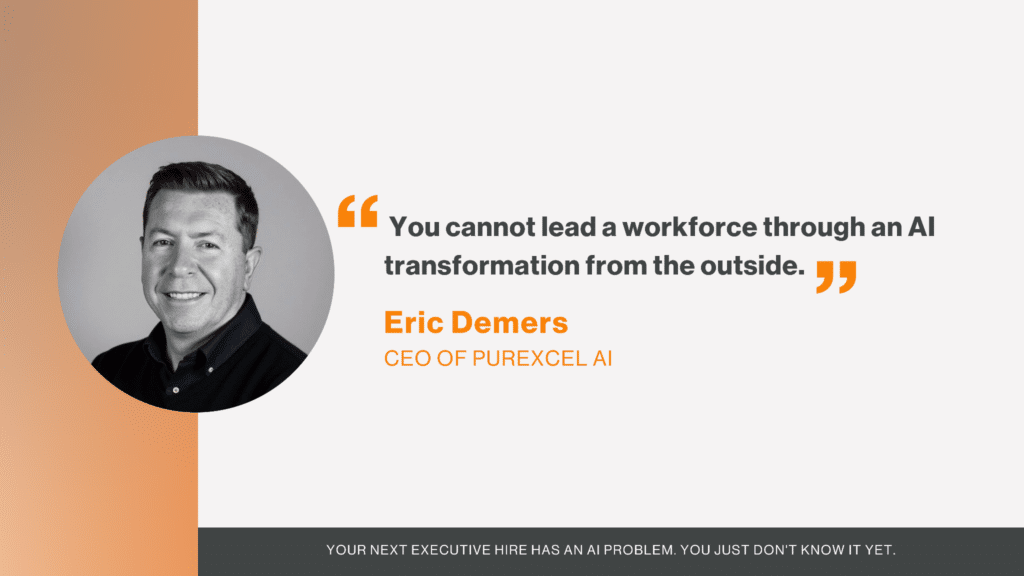
Eric Demers is the CEO of PureXcel AI and an operator and advisor who has led AI-driven transformation across multiple industries and C-suite functions. He is a member of the ChasmCollective, a curated network of functional experts available to assist Chasm clients as they build and scale their leadership teams.
We sat down with Eric for a conversation that got uncomfortable fast. That was the point.
You open with a pretty blunt premise. What is it?
Most companies are about to make a very expensive hiring mistake, and they won't realize it for 18 months.
They're running executive searches the same way they did five years ago. They're screening for domain expertise, industry pedigree, leadership track record. All important. But they're not seriously asking: how does this person think about AI, and what are they actually doing with it? And because nobody's asking, candidates aren't being honest about it either. You're getting people who can talk around the topic just well enough to pass, and then you're putting them in seats where that gap is going to matter enormously. It's going to cost you.
Why is this such a hard thing to surface in a search process?
Because AI fluency is easy to fake in an interview. Everyone has the vocabulary now. Everyone can drop the right buzzwords and describe a use case they read about. But there's a massive difference between someone who is genuinely living in this, experimenting, adapting, making real decisions informed by what AI can and can't do, and someone who is quietly running from it while performing confidence.
And here's the uncomfortable part: a lot of the people running from it are senior executives. They got where they are through decades of pattern recognition, relationships, and experience. AI doesn't fit neatly into any of that. It's new, it's fast, it's humbling. So some of the most credentialed candidates in the market right now have the biggest blind spots, because they have the most to protect.
That's a provocative claim. Make the case.
Look at what's happening at the very top of the AI industry itself. OpenAI, the company literally building this technology, has a public rift between its CEO and CFO. Sam Altman is pushing for an IPO while burning through capital at a rate projected to exceed $50 billion annually by next year. His CFO, Sarah Friar, has been sounding the alarm internally, raising questions about whether the revenue growth actually supports the spending commitments and whether the organization is ready for public-market scrutiny. She's not even in his direct reporting line anymore.
Think about that. The company at the center of the AI revolution can't get its CEO and CFO on the same page about what this technology is worth and what it will cost. If that tension exists at OpenAI, imagine what's happening in the average mid-market company where the CFO has never had to model AI infrastructure costs, the CRO has never had to explain how AI changes their pipeline assumptions, and the CEO is getting asked by the board to have answers they don't actually have yet.
That's not a technology problem. That's a leadership fluency problem.
So what does this actually look like inside a company?
It looks like paralysis dressed up as prudence. Leaders who don't feel confident about AI tend to do one of two things: they either greenlight a vague, expensive initiative to look like they're doing something, or they do nothing and rationalize it as "waiting for the right moment." Neither is a strategy.
Meanwhile, their teams aren't waiting. Employees across every function are already using AI tools off the sides of their desks, without permission, without policy, without any guidance. We've been here before. When smartphones arrived in the enterprise, IT departments woke up one day to find thousands of apps running on devices connected to their networks, touching customer data, creating security exposures nobody had planned for. Entire industries were built just to clean up that mess.
AI is the same cycle, moving ten times faster. And the leaders who should be getting ahead of it are either unaware that it's already happening, or they know and are hoping nobody asks.
What does good actually look like? What are the leaders who are getting this right doing differently?
They're doing three things that most aren't.
First, they're using the tools themselves. Not delegating. Not asking for a briefing. Actually using them, getting their hands dirty, being willing to be bad at it before they're good at it. That's what builds genuine intuition, and it's the only thing that does. You cannot lead a workforce through an AI transformation from the outside.
Second, they're making the distinction that almost nobody is making clearly. AI as a product strategy and AI as an operational strategy are two completely different problems. The first is about what you're building and selling. The second is about how your people work, how your costs are structured, how your organization scales. Most companies are putting all their energy into the first and ignoring the second, and that's where the hidden competitive disadvantage is accumulating, quarter by quarter.
Third, they're building it into their hiring process, not just for dedicated AI roles but for every senior role. A CFO who can't engage meaningfully with AI cost modeling is a liability. A CRO who doesn't understand how AI is changing buyer behavior is already behind. A COO who hasn't thought about which operations AI can transform in the next 24 months isn't planning. They're guessing.
What's the cost of getting this wrong?
Compounding. That's the word I'd use. The organizations moving aggressively on AI right now, with the right leaders in place who are informed, curious, and willing to act, are not just pulling ahead. They're changing the economics of their industries. Shaving cost structures that their competitors are still carrying. Moving through sales cycles faster. Innovating on products with smaller teams. The gap they're building isn't linear. It compounds every quarter.
And the organizations waiting for certainty? Certainty isn't coming. There has never been a moment in this technology cycle where you could wait, feel comfortable, and still catch up. The companies that treated the internet that way in the late '90s, that treated mobile that way in the early 2010s, most of them don't exist anymore, or they exist as a fraction of what they could have been.
AI is not different. It's just faster.
Last question: what should a CEO or board be asking that they're not asking right now?
One question above all others: Does every leader in this organization have enough AI fluency to make consequential decisions in their function, not someday, but today?
Not "are we using AI?" That's the wrong question. It's too easy to answer yes with a pilot program nobody is paying attention to. The right question is whether the humans making decisions at the top of your organization understand the landscape well enough to lead through it. Because if they don't, no amount of technology investment beneath them will matter. You'll buy the tools, you'll run the pilots, and nothing will change, because change at that scale requires leadership that actually believes it's possible and knows enough to make it happen.
That's the question. Most boards aren't asking it. They should be.
ChasmConversations is an interview series presented by Chasm Partners featuring discussions with prominent operators, investors, and leaders across technology and services. To read previous installments, visit chasmpartners.com/insights. Subscribe to receive future editions directly in your inbox.