ChasmPOV: September 2026 Edition
In the latest installment of our ChasmConversations series, we sat down with Leslie Glenn, Founder of Ravel Talent Advisors, a fractional and advisory HR practice focused on VC- and PE-backed healthcare companies. Leslie has held multiple CHRO and CPO roles throughout her career and works closely with founders, CEOs, and PE sponsors on people strategy. Leslie is a member of the Chasm Collective, a curated network of functional experts in the healthcare technology and services space available to assist Chasm clients achieve scale.
We talked with her about a gap she's seeing across the industry: healthcare companies are investing heavily in AI for their products, but leaving significant opportunity on the table in how their own employees use it to work differently, scale faster, and grow without adding headcount at the same rate.
You work across a lot of VC- and PE-backed healthcare companies. What's the AI conversation sounding like from your seat right now?
The clients I've worked with over the last two years are all talking about AI, but in terms of their products. The board is asking questions, customers are asking questions, and tech resources are all focused on the product offering. But when I ask about internal AI use or adoption, I frequently hear "we aren't allowed to use ChatGPT or Claude." The reality is that people are using it off the sides of their desks without permission and without proper safety protocols in place.
I've been in boardrooms where board members are asking pointed questions about AI strategy, and the conversation is entirely product-focused. Not everyone is asking how employees are using AI, whether there's a plan for it, or what the company is leaving on the table by not having one. There's a gap between AI as a product strategy and AI as a workforce strategy, and the companies I've worked with and the people I know in this space haven't closed it. They are different problems. Product AI is about what you’re building and selling. Workforce AI is about how your people actually work, what tools they have to do it, and what productivity gains and growth levers can be realized—all of these matter. Most companies are only working on one of these.
What does that gap actually look like in practice?
Across my clients, including companies of all sizes, the common thread is that AI strategies, when they exist, rarely speak to the workforce. And when a policy does exist, it's often just a policy that says 'don't use ChatGPT.' Often, there are no approved tools, limited guidance, and little to no training. Data and privacy concerns are real, especially in healthcare, but a prohibition alone isn't a strategy. What makes it harder is that in many cases, the executives themselves aren't comfortable using AI. And when leadership isn't using it, it stops being a priority. Maybe they'll ask their CTO or someone else on the leadership team for a perspective, but then nothing happens, given their organization's span of control. As a result, it sits on a list somewhere.
"A prohibition alone isn't a strategy."
Can you give a concrete example of where you see the missed opportunity?
HR is a good one because I live in it, but this pattern repeats across most functions. Many smaller healthcare companies use a single Human Resources Information System (HRIS) with modules for performance, compensation, and recruiting. Many of those legacy systems have not kept up with AI, or they are in such early stages that you are paying for very little benefit at this stage.
Take engagement surveys. You run one in your HRIS, and the data sits there. With AI, you could go from raw responses to department-level scores, manager-by-manager satisfaction, and a tenure curve that flags where people start to disengage. You can spot trends before they turn into resignations. That's a genuine impact with significant consequences to the business. Most legacy systems still aren’t doing any of that.
Or take performance management. AI can let managers run weekly 1:1s, capture the notes, and at review time pull a draft assessment grounded in what actually happened over the past six months, not what they remember from last week. The same data can flag underperformance early and give managers specific coaching language. Those tools exist, but they cost extra and sit in a separate system from the HRIS, so most smaller companies skip them.
It’s one example that can also be replicated across finance, operations, customer success, and beyond. The opportunity is there for businesses. Most companies just aren’t capturing it for a few reasons. They’re locked into multi-year HRIS contracts and assume the platform they’re already paying for will catch up. Privacy concerns feel especially heavy in healthcare, so the default answer is ‘not yet.’ And nobody internally owns AI, so it sits on the list of things everyone agrees are important, but no one is actually moving forward.
The fix isn’t complicated. Name an owner with authority and a meaningful budget. Pick one or two use cases with clear business impact and run a pilot. Layer AI tools alongside the HRIS instead of waiting for the HRIS to catch up. And get the executives using the tools themselves, because that’s what turns it from a wishlist item into a priority that cascades across the organization.
These are examples where employees are already creating their own workarounds using ChatGPT or Claude to get there, but doing so without any policy, guidelines, or oversight on how these tools are being used or how data is being managed. The opportunity and the risk of leaving it unmanaged are both very real.
How does HR end up in the middle of this?
You can see how it gets there. It touches culture, change management, and how people work. But what I'm increasingly seeing is HR leaders being asked to own not just the people dimensions of AI, but also the organization's entire workforce AI strategy. HR is part of the leadership team and the people strategy. Change management, training, the culture shift—that's squarely in HR's lane. The internal AI strategy, though, needs to be owned across the leadership team. When there's no shared ownership and no clear mandate, it stalls regardless of who's holding it.
Why do you think the employee side gets so deprioritized?
Part of it is where leadership attention naturally goes. If you're a CEO or a board member, you're focused on the market opportunity, the competitive landscape, and what your product can do. The workforce application of AI feels more operational. It doesn't show up in a business development pitch deck.
It's also harder to measure. Product AI has clear metrics: customer adoption, revenue impact, and time to launch. Workforce AI is messier. The gains show up across every function in small ways, hours saved here, a faster decision there, a manager who finally has time to coach. It’s harder to put on a slide, so it gets less airtime even when the cumulative impact is bigger with Product AI.
And honestly, a lot of leaders aren't comfortable using AI themselves yet. When you're not using a tool, you don't know what to ask for, you can't tell good adoption from bad, and you don't lead on it. So it gets delegated and quietly stalls.
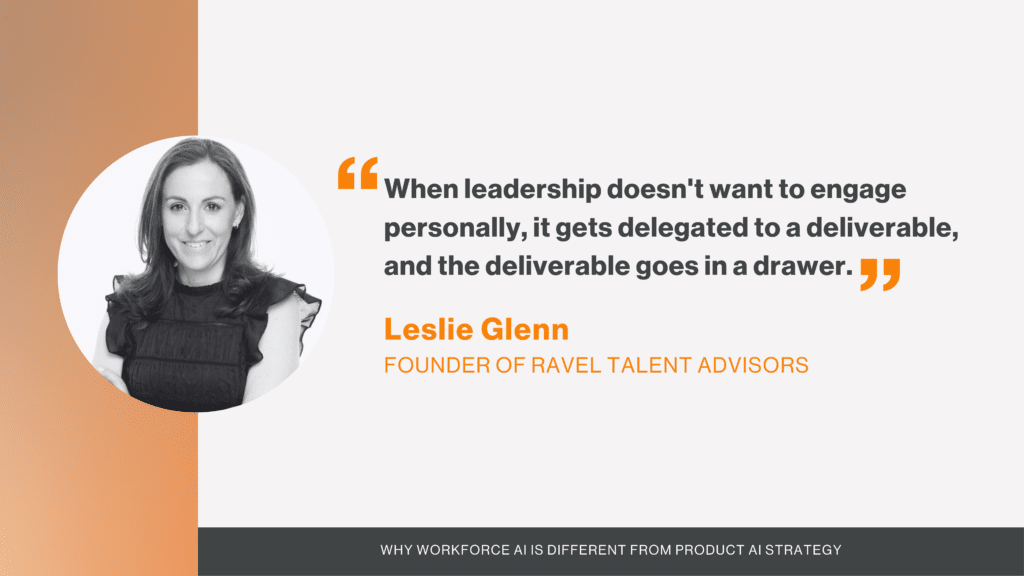
I had one CEO who I have been advising respond to a conversation about executive AI adoption by asking their Chief Product Officer to inventory every AI tool being used across the business. The report came back. Nothing happened with it. That's what it looks like in practice. When leadership doesn't want to engage personally, it gets delegated to a deliverable, and the deliverable goes in a drawer.
But there's also a people element that gets underestimated. Employees are anxious about AI. I hear it directly in conversations with HR teams and frontline staff. The fear isn't abstract. People genuinely worry that AI is going to take their jobs. And if leadership isn't actively addressing that narrative and replacing it with something better, it just festers.
What's the reframe you give to employees who have that fear?
I tell them that where I see this working, AI is reshaping roles, not eliminating them. A recruiter who uses AI to screen, summarize, and draft isn't being replaced. They're handling a pipeline that would previously have required two or three people. An HR business partner who uses AI to field policy questions and triage employee issues can spend their time on the work that actually requires human judgment.
Refusing to use AI is the career risk now, more than AI itself. That's the harder conversation to have, but it's the honest one.
So what does a workforce AI strategy look like?
The companies doing this well are treating AI adoption as a talent strategy, not just a technology rollout. That means a few concrete things.
First, give employees access and permission: approved tools, clear guidance on what's appropriate to use them for, and actual training. Not a policy memo. Second, tie AI use to specific roles and specific outcomes. Not "everyone should be using AI more," but "here's how your recruiting team can cut time-to-screen in half" or "here's how your finance team can automate the reporting that's eating their Fridays." The use cases have to be concrete.
Third, and this is the part that often gets skipped, have the scale conversation honestly. AI rewrites how a company grows, not just how individual jobs get done. A team that might have needed eight people to hit a certain output can hit it with five, and those five can do more. That's a shift in how you plan headcount, and the CHRO needs to be in that conversation from the beginning.
"AI rewrites how a company grows, not just how individual jobs get done.”
ChasmConversations is an interview series presented by Chasm Partners featuring discussions with prominent entrepreneurs, investors, and leaders in today's healthcare industry. Access previous installments of the series here, and subscribe to receive future editions of ChasmConversations and related content directly in your inbox.