A CEO Reality Check: Uncovering Organizational Blind Spots
This is The First of a Two-Part Series
As companies grow, CEOs often become further removed from their organizations' day-to-day operations. This distance can create blind spots, making it harder to recognize challenges and make informed decisions.
In this excerpt from her book CEO Unbound: Throwing off the Shackles that Impede Growth, Christine Britton explains how CEOs can better understand their organizations by listening to candid feedback from employees at every level.
About Christine Britton
Christine Britton is an executive coach, strategic advisor, and author with more than 30 years of experience in executive coaching, leadership development, and organizational effectiveness. She works with growth-stage CEOs and senior executives as they navigate complex business challenges. At Chasm Partners, Christine coaches senior executives and conducts leadership assessments in support of investment due diligence. She holds a Master of Science in Management for Organizational Effectiveness.
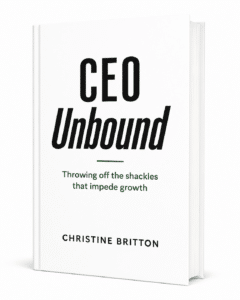
From CEO Unbound: Throwing off the Shackles that Impede Growth
Most CEOs assume they know what's going on in their organization. But as your company grows, your visibility decreases.
Early on, you are in the middle of everything. You hear conversations directly. You see problems as they emerge. You know what customers are saying, what your team is struggling with, and where the friction points are.
CEO Isolation is a Structural Reality
As the organization increases in size and complexity, you begin to lose that proximity. Information starts to travel through layers. Messages are shaped, softened, and sometimes withheld entirely. People become more cautious in what they share with you — not because they are dishonest, but because of the natural dynamics of power and hierarchy.
People want your approval, so they carefully manage what they share. They may hesitate to bring you bad news, filter issues before escalating them, and present a more optimistic version of reality than what's actually happening.
The Cost of Blind Spots
Meanwhile, the pace of the business accelerates. You are making decisions faster, with more at stake, and often with less complete information than you realize. You develop blind spots.
When CEOs operate with incomplete or filtered information, the consequences show up in subtle but significant ways: strategic misalignment across teams, persistent operational inefficiencies, declining engagement or rising turnover among key talent, missed opportunities for innovation. These issues rarely present themselves clearly. Instead, they emerge gradually — and are often visible to others in the organization long before they reach you.
The Fix
You've probably run 360-degree reviews on individual leaders. The organizational 360 is the same idea, aimed at the whole company instead of one person — and it's the single highest-leverage conversation most CEOs never have.
Here's how I run one. I call 20 to 25 people, handpicked by the CEO for a real mix of function, level, and tenure — from the four-month hire to the nine-year veteran, from engineering to customer success. I ask each of them three questions: What do you love about working here? What improvement or innovation would you be thrilled to see? What advice do you have for the CEO?
The first question is disarming — most people haven't been asked it in years. The second gets them thinking about contributing to making things better. The third is what draws out the insights the CEO hasn't heard before.
People tell me things they'd never tell you. Not because you're a bad listener — because the stakes are different. I promise them that nothing they say gets attributed, that I only report patterns that surface across multiple people. I leave extra time beyond the scheduled ending of every call, because often the most honest input comes in the last three minutes, after someone has formulated their true thoughts and decided it's safe to tell me.
The Insights
The resulting report is organized by theme, supported by blinded quotes. If eleven people across four functions independently raise the same issue without prompting, that's a finding. I send the report in advance, then walk the CEO through it.
It also hands you an honest read on your executive team: who's building a bench so they're never the bottleneck or has the whole department routing every decision through their desk. You'll gain insight into your team's real capability — and whether the gaps are bridgeable. And you get a free CEO 360 — because "what advice do you have for the CEO" always circles back to you. Changing priorities too often. Too absent or too in the weeds. Protecting the wrong person. It's not always comfortable, but it’s almost universally the most useful part of the process.
One CEO I'd been working with for about three months asked me to run one. Twenty-three interviews later, the themes were remarkably consistent, and some of what surfaced genuinely surprised him. He spent the next several months making deliberate changes. A year later, he told me: "Your report was right about everything. Some of it I knew. I didn't realize how many other people saw it too — and how urgent it had already become."
Make the List and Ask the Questions
Write down 20 to 25 names — people across every function, level, and tenure whose honest input would give you a real read on where your company actually stands. An HR leader or Chief of Staff you trust can run it internally and get you real insight. An outside party will get you more candor.
Either way, ask the question and listen carefully. The answer is already sitting in your building.
Christine Britton is the author of CEO Unbound. She serves as a strategic consultant, coach, and trusted advisor to growth-stage CEOs and senior executives. CEOs are invited to book a complimentary strategy consultation with Christine here.
To purchase a copy of CEO Unbound, please click here.